
A fractional CFO is a senior finance person who works with your business part-time, on a scope you agree on. The job is to take your financial information and turn it into decisions about cash flow, margins, pricing, hiring, and growth.
For a trades owner, it usually starts with a simple question. Can we afford the next crew hire? Another truck? That big job? Working in more locations? The answer depends on knowing what’s working and what’s not in each part of your business. Sometimes the first step is making sure you’re working with clean numbers. From there, you figure out what to fix first: bookkeeping cleanup, a reliable month-end close, clearer job-cost information, or a cash-flow forecast.
Think of a fractional CFO as the layer on top of good bookkeeping. You need it when you want your numbers to answer more than “how did we do last month?”
Why a P&L isn’t enough when you’re running crews?
You’re bidding work, managing crews, ordering materials, and chasing invoices. Often all in the same afternoon, right? The business looks busy. It might even look profitable on paper. But you still can’t say how much cash you’ll have in six weeks, or how much you’ll actually keep from the job you just finished. I’ve talked with hundreds of business owners, and I hear some version of this a lot: “How can our profit margins be that good and we still struggle?” Here’s the thing. Profit does not equal cash.
You’re not alone. According to the SBA, about half of new businesses with employees close within five years. [3] And in the Federal Reserve’s latest survey of small employers, 51% said uneven cash flow was a challenge. [1] If you don’t have access to cash in some way, shape, or form, you may find yourself closing up shop.
So does every business need a fractional CFO? Nope. The question I’d ask is whether your numbers reach you early enough, and clean enough, to make your next big decision with confidence.
How bookkeeping and CFO-level support work together?
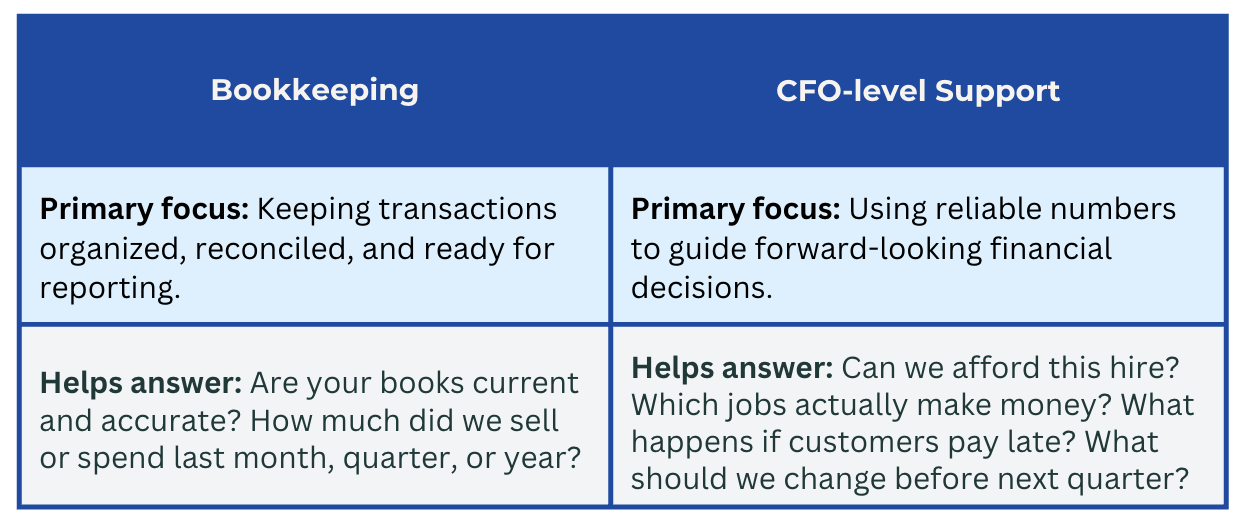
The sequence matters. If the books are behind or incomplete, or the reports show up too late, a CFO review won’t be worth much. Sometimes that means fixing the foundation first. Then we move into cash planning, job margins, and what-if scenarios, so you’re making decisions with real data behind them.
What a fractional CFO actually does?
What I do depends on your business and the scope we agree on. It should match your goals and what you actually need. For a trades business, it can cover some mix of these:
So what do I do with these reports?
Your P&L and balance sheet are important. But they won’t tell you what to do next. A CFO connects the reports to the decisions you actually have to make: hiring, pricing, crew capacity, equipment, supplier commitments, or a new service line.
The goal is a clearer way to make decisions with your numbers. (Trust me, nobody needs more reports.)
Will I have enough cash in six weeks?
Cash planning is about timing. When is money likely to come in, and when does it go out? That means expected customer payments, payroll, materials, subs, equipment, loan payments, insurance, and anything else that’s due.
A forecast is an estimate. It’s your assumptions, written down. So when a customer pays late, a start date slips, or materials go up, you update the forecast and see the impact while you still have time to act.
Sending an invoice is NOT cash in the bank. And loan principal payments and estimated tax payments don’t show up on your P&L, but they sure do impact your cash.
Which jobs are actually making money?
You can win a job and still lose margin. Untracked labor time, materials, sub costs, rework, scope changes, or a bad estimate will eat it. If your records and systems can support it, we dig into job-cost and project-margin numbers so you can see which work is helping the business and which work needs attention.
Not every project or trade gets measured the same way, either. The reporting should fit how your business actually runs: your workflow, cost categories, billing process, and systems.
Can I afford this before I commit?
Decisions are better when you can test the assumptions before the money’s spent. A fractional CFO can help you model what a new hire, equipment purchase, pricing change, bigger project, new debt, or growth investment would actually do to the business.
Here are the questions I’d ask:
What cash does this commit you to, and when does it start?
What revenue or margin do you need to support it?
What happens if a customer pays later than you expected?
What would change your mind?
What needs to be true before you say yes?
Making it a habit
A one-time analysis is nice. A regular review is what builds the habit. How often depends on how complex the business is. If your job schedules shift a lot, you run payroll often, and you’ve got material commitments, you probably need to look at cash more often than a simpler operation does.
A good review covers five things:
What happened since last time: revenue, margin, cash movement, and any big variances.
What’s coming next: customer payments, payroll, materials, subs, equipment, and other commitments.
What changed: job timing, scope, costs, aging receivables, or your assumptions.
What decision needs to be made before the next review.
Who owns the next step, and when we’ll check on it.
The SBA recommends regularly comparing what you expected with what actually happened. They call it plan-versus-actual analysis. [2] It’s also how your next forecast gets better.
What I can’t promise?
I can help you see more clearly, build a better process, and make better decisions. What I can’t do is guarantee profit growth, cash in the bank, that customers pay, loan approval or terms, how a project turns out, or that the business stays solvent.
Uncertainty doesn’t go away. Good financial support just makes it easier to see and manage.
Signs you might need more support
There’s no magic revenue number that says you’re ready for CFO-level support. But if two or more of these sound like you, it’s worth a Financial Assessment:
You’re bringing in revenue, but you can’t clearly explain where the profit is going.
Cash feels unpredictable, even in strong months.
Big decisions about hiring, equipment, pricing, or growth get made mostly on feelings.
Reports are late, incomplete, or hard to use.
You can’t see whether a job made money until it’s done.
Customer payment timing is putting pressure on payroll, materials, or other bills.
You’re heading into a conversation with a lender and need cleaner projections and financials.
You’re still the only person who can explain what the numbers mean for the next decision.
The answer might be bookkeeping cleanup, a better close process, job-cost reporting, a cash-flow forecast, CFO-level support, or some combination. A good first conversation should find the real gap, not push a pre-set package.
A simple decision check for owners
Before your next big decision, try answering these four questions with the numbers you have today:
What is the decision? For example: a crew hire, a vehicle, equipment, a pricing change, or a large job.
What will it cost, and when will the cash leave the business? Include the upfront cost and the ongoing commitment.
What cash is expected to arrive before then? Use realistic payment dates. Signed work and unpaid invoices aren’t cash yet.
What changes if one big assumption slips? Test a late payment, a schedule change, or a higher cost.
If these are hard to answer, it doesn’t mean you lack ambition. It means you can’t see your numbers clearly yet. That’s where cleaner records, better reporting, or CFO-level planning can help.
Frequently Asked Questions
Is a fractional CFO the same as a bookkeeper?
No. Your bookkeeper keeps the records organized and produces the reports. A fractional CFO uses those reports to help you make decisions about cash, margins, pricing, hiring, and growth. Lots of businesses need both, just not always at the same time or at the same level.
When should a trades business consider a fractional CFO?
When your big decisions need more forward-looking information than you’re getting now. For example: cash surprises that keep happening, project margins you can’t see, a growth decision, a lender conversation, or you carrying all the financial interpretation by yourself.
Can a fractional CFO help with cash-flow forecasting?
Yes, depending on the scope and how good your records are. We map out the payments you expect to receive and make, test the assumptions, and set up a regular review. It won’t guarantee cash or stop every surprise.
Does a fractional CFO guarantee higher profits?
No. No one can guarantee how your business will perform. What CFO-level support does is improve the information and the process behind your cash, margin, pricing, and growth decisions.
Need a clearer view before the next big decision?
Cloud9 Financial provides bookkeeping and CFO-level insight for owners who want clearer numbers and a stronger path to growth. In a Financial Assessment, we’ll look at your goals, your financial challenges, and the decisions in front of you, then talk about what kind of support would help.
Book Your Financial Assessment
Educational notice: This article is general business-finance education, not legal or tax advice. I’m not a lawyer or a tax accountant. Financial forecasts are estimates based on assumptions. They aren’t audited or reviewed financial statements, and they aren’t a guarantee of revenue, profit, cash, payment, financing, or solvency. Every business is different, so base your decisions on your own facts and circumstances.
References
[1]: https://www.fedsmallbusiness.org/reports/survey/2025/2025-report-on-employer-firms "2025 Report on Employer Firms: Findings from the 2024 Small Business Credit Survey"
[2]: https://www.sba.gov/blog/5-classic-fails-budgets-forecasts "5 Classic Fails in Budgets and Forecasts"
[3]: https://advocacy.sba.gov/2026/02/03/frequently-asked-questions-about-small-business-2026/ "Frequently Asked Questions About Small Business, 2026" (SBA Office of Advocacy, BLS Business Employment Dynamics data)